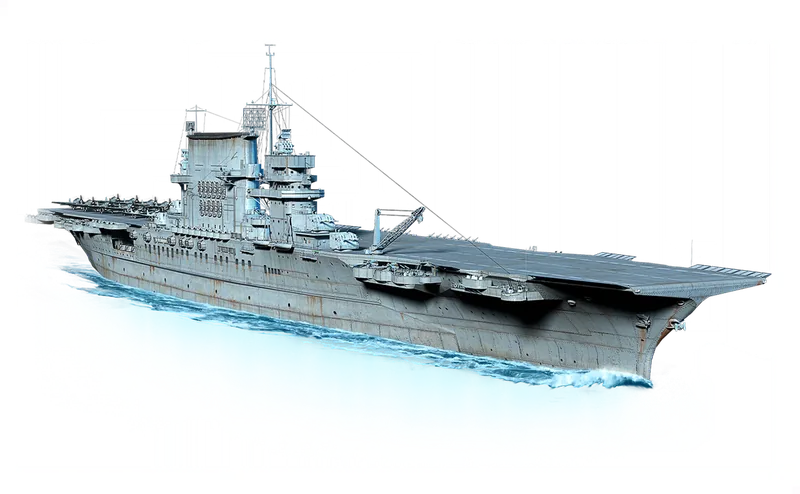
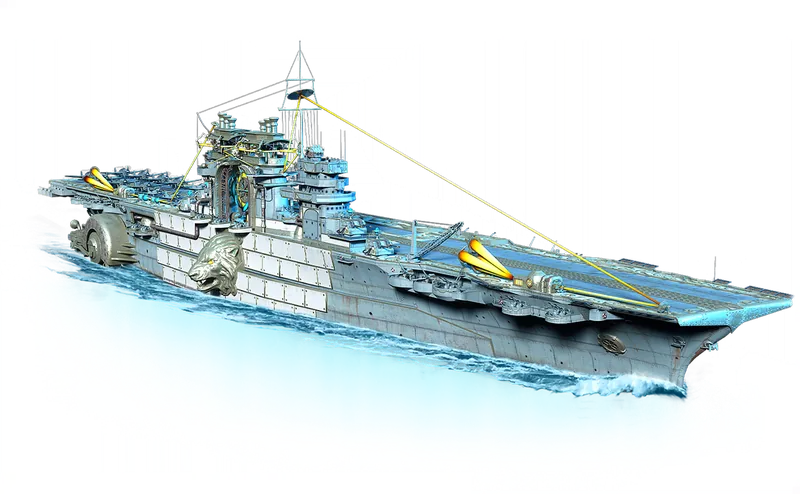
Lexington
Also called: 列克星敦 Beta- Stay a full map cell behind the brawl line, far enough back that a rotated DD or radar cruiser cannot threaten the hull
- Launch from positions where the recall path stays inside your team's AA umbrella
- Avoid: Trading a full squadron for one high-value kill
On this page
Lexington Community Stats
Log in to GamingDiver and upload your data to see Community Data for Lexington: community win rate, damage, survival, spotting, and your own comparison.
Lexington Community Stats
Record History
Playstyle
Overview
Lexington is the Tier VII American bomber carrier. HE dive bombers are her main battery, hitting for up to 6,200 per drop, so match impact comes from repeated bombing runs on broadside and angled targets rather than a single torpedo strike. Air torpedoes are a secondary option. The hull also tanks unusually well for a CV (57,300 HP, cohort-best), so she can stay in match longer than peer carriers. AA (876 AA DPS at 5 km) is heavy enough to make her the team's air-defense anchor; CV strikes route around her, not through.
Positioning
Stay a full map cell behind the brawl line, far enough back that a rotated DD or radar cruiser cannot threaten the hull. Launch from positions where the recall path stays inside your team's AA umbrella, not over open water where intercepting fighters can finish off limping squadrons. Longer trip back, fewer waves per match. You are spotted at 14.5 km and run at 33 kn, so that distance plus your speed is the whole margin for noticing a DD has slipped past and getting out. Both phases of a turn are slow (15.7 s on the rudder, a 1,180 m circle), so course changes are a plan rather than a reaction: set the angle before you are shot at.
Potato Avoidance
Trading a full squadron for one high-value kill
Match impact comes from cycling waves across multiple targets, not committing a dive into layered AA for one battleship. When a target's AA is heavy, route around and find a softer pick rather than burning planes through the wall. Replacing a lost aircraft takes 32 s at best, and your most fragile squadron flies at 2,550 HP, so a wave sent into a wall of AA thins the reserve for the rest of the match.
Signature Traits
57300 HP, best of T7 CVs.
- Top-tier AA · 876 AA
- AA specialist
28700 HP flight deck, top decile of T7 CVs. Survives AP and HE pressure that peers can't.
- Thickest plate · 178 mm
- Heavy citadel belt · 178 mm
~36.4 s to 90% of top speed, worst of T7 CVs. Sluggish rebuild after a turn or stop; the engine power-boost fades early, so the mid-range crawls.
1.5 km torpedo detect, bottom decile of T7 CVs. Targets spot the drop early.
How to get Lexington
Lexington is available in the Bomber Carriers branch of the U.S. Tech Tree for 23,000,000 credits after researching it in the branch. Known module upgrades cost up to 4,650,000 credits.
Show U.S.A. tech-tree branch diagram
Lexington sits in the Bomber Carriers branch. The highlighted path shows the local branch context inside the full U.S. tree.
U.S. aircraft carriers are all-rounders, effective with both dive bombers and torpedo bombers. However, they have a bias toward their powerful high-explosive bombs over torpedoes.
- Advantages
- Powerful HE dive bombers, Large hangars
- Disadvantages
- Poor torpedo performance
Builds
Pair with a commander whose unique skill complements her main armament; check the build tool for current recommendations.
Have a build you swear by? Open it in the Build Tool and hit Save build to share it here.
Cohort position
Hide
▾
Where Lexington sits among Tier VII CVs (10 ships). Notable standouts are shown first; the rest of the cohort-ranked stats are in the expand below. Acquisition variants (Black Friday, Founders Edition) are counted once with their base ship, not as separate peers.
See 17 mid-pack stats
Not standouts for Lexington -- here's where she sits on every other ranked stat in the cohort. Stats tagged NORM are tied across more than half the cohort, so the value is the cohort default rather than a standout.
Peers in this cohort
Compare Tier VII Aircraft CarriersShow all 10 peers
Stats & specs
Customize in the Build Tool →ƒ
Longest-reaching family on the in-game AA card. Base AirDefense aura max range is 3.5 km; dual-purpose mount auras extend it.ƒ
Dual-purpose: your secondaries doing double duty against aircraft. The same mounts appear on the Secondary Battery card - shared guns, not extra hardware.ƒ
Effective DPS in in-game units (raw aura damage × 3.5 × hit probability, summed per contributing aura) - matches the Close-range AA DPS headline's currency. Includes 140 from dual-purpose secondaries firing as AA in this range band.ƒ
Effective DPS: 180 raw aura damage × 3.5 × 1 hit probability = 630 - the same in-game units as the Close-range AA DPS headline.ƒ
Far 140 + Medium 630 = 770ƒ
Effective DPS: 32 raw aura damage × 3.5 × 0.95 hit probability = 106 - the same in-game units as the Close-range AA DPS headline.ƒ
Far 140 + Medium 630 + Near 106 = 876ƒ
Each ~2 s wave fires 2 quick salvos of 4 clouds ahead of the attacking squadron, plus 2 stray clouds farther out that appear off-beat between waves - up to 10 clouds per wave × 220 damage each. Planes that fly into a cloud take its damage; clouds dissipate before the next wave lands. Defensive AA Fire, where fitted, multiplies the salvo repeats within each wave.ƒ
Damage a plane takes for flying into one flak cloud, before any reductions.ƒ
Every potential cloud spawns - the full pattern, every wave. Often called flak 'hit chance', but spawned clouds always damage planes that fly into them - the roll is on spawning.ƒ
A flak wave spawns roughly every 2 s - timed frame-by-frame from gameplay footage and consistent across ships.ƒ
Flak keeps firing while at least one secondary battery mount is operational - even losing every other AA mount does not stop it.ƒ
The activation band: flak fires while attacking planes are inside it. Clouds are placed ahead of the planes' path, so bursts can land short of 2.5 km or past 5 km - once planes get inside the band, new waves stop. AA range bonuses push the outer edge out; the 2.5 km inner edge does not move.ƒ
Max dispersion = range (km) × 45 + 30. Each dispersion type sets its own slope; this is not a percentage applied to a standard baseline.ƒ
4.5 km × 45 + 30 = 232.5 m.ƒ
Dual-purpose: the same mounts also fire at aircraft, so they appear on the AA Defense card too - shared guns, not extra hardware.Show 1 more gun family
ƒ
Dual-purpose: the same mounts also fire at aircraft, so they appear on the AA Defense card too - shared guns, not extra hardware.ƒ
top speed / 4 + 4.9 = 33 / 4 + 4.9 = 13.2 kt. The community reverse-speed model from the WoWs ShipBuilder project, the same source as the acceleration model on this card. Base value; speed modifiers scale it. Not shown on the in-game card.ƒ
Seconds from top speed to a dead stop after ordering full reverse: reverse power winds in over the reverse spool-up while water drag does most of the braking. Same community-model simulation as the acceleration times, using the ship's own reverse-power ratio from in-game data. The full curve is on the acceleration chart.ƒ
Speed below which the engine's built-in power boost applies in reverse. Matches the in-game maneuverability card's reverse threshold (Vampire II reads 10.5 here and the card shows 11; the card rounds half up).ƒ
Time to reach 90% of top speed (29.7 kt of 33 kt), from our in-house acceleration model.ƒ
Time to reach 99% of top speed (32.7 kt of 33 kt). 99% rather than 100% because true top speed is asymptotic (thrust meets drag), so the last fraction of a knot is never quite gained.ƒ
Air detectability plus the gun-firing bloom (0 km, which tracks main-battery caliber x 0.020). Matches the in-game 'Detect Firing Air' value on every captured ship.ƒ
Base sea detectability + 2.0 km while burning; matches the in-game 'Detect Fire Sea' value on every captured ship.ƒ
Base air detectability + 3.0 km while burning; matches the in-game 'Detect Fire Air' value on every captured ship.
Automatic Damage Control Party∞ charges · 90 s reload · 60 s active
Automatic Fighter4 charges · 40 s reload · 150 s active · 5 km patrol radius ƒ
Derived from the consumable's 30 m grid-unit range (km = grid units x 30 / 1000):
See all derived stats
Show
▾
All values are ship base stats with modifications and upgrade changes denoted inline.
Numbers the spec table cannot show directly: alpha-strike math, DPM, dispersion, AP penetration. Click the formula chip on any row to reveal how it is calculated.
AA defense
Only families that reach 5 km contribute at the outer edge of the AA bubble. In-game families: 40mm Bofors Mk1 2x2 -> 50 DPS @ 3.5 km; 40mm Bofors Mk2 23x4 -> 580 DPS @ 3.5 km; 20mm Oerlikon MK4 16x1 -> 106 DPS @ 2 km; 5in38 Mk32 Mod12 4x2 -> 47 DPS @ 5 km; 5in38 Mk24 8x1 -> 93 DPS @ 5 km.Longest-reaching family on the in-game AA card. Base AirDefense aura max range is 3.5 km; dual-purpose mount auras extend it.Cumulative AA DPS at each family range threshold. Inner ranges stack the outer families, so a target closing the distance hits stronger AA bubbles as it crosses each band.Sum of every family's average DPS, achievable only inside the closest-range family (2 km).SUM over AA auras of (aura DPS x aura range km). A plane crossing the AA bubble is exposed to each aura for a time proportional to that aura's range, so long-reach DPS is worth more than the same DPS in a short bubble. Units: DPS*km; used to rank overall AA threat across the cohort.Secondary battery dispersion
Max dispersion = range (km) × 45 + 30. Each dispersion type sets its own slope; this is not a percentage applied to a standard baseline.4.5 km × 45 + 30 = 232.5 m.Secondary battery firepower
Sum across all secondary families of (per-side barrels × 60 / reload_s × alpha), where per-side barrels = mounts × barrels-per-mount / 2 (the guns that bear on one broadside target). Per-family: 4×2 127 mm (4/side) × 60/6 × 1800 = 72,000 + 8×1 127 mm (4/side) × 60/6 × 1800 = 72,000. Assumes every shell hits (real hit rate is lower; the Brawl matchup tool on the Compare page folds in dispersion + target armor).Maximum HE damage per shell across secondary HE families. Best on this ship: 1800 from the 127 mm family.Maximum per-shell fire chance across secondary HE families (before target fire resistance is applied). Best on this ship: 5% from the 127 mm family.Maximum HE armor penetration across secondary HE families (caliber × 1/6 for most nations; 1/4 for German/UK BBs). Shells whose pen falls under a plate's armor thickness shatter for 0 hull damage though fire chance still applies. Best on this ship: 21 mm from the 127 mm family.Armor Beta
Hull HP 54,300 → 57,300 with hull upgrade, distributed across 5 hull zones, each with its own plate thicknesses, saturation cap, and pen thresholds. HP caps are the exact in-game values, not estimated.
Overmatched by 136+ AP guns across the bracket. Can’t reliably bow-tank; gets bow-citadelled and overpenned.
AP can citadel a flat broadside even at range. Stay angled and avoid showing the full side.
Superstructure and extremities take HE pens and AP overpens from nearly any gun: steady chip damage. Fire resistance 37%, fires burn 60s. Range-by-range in the Compare tool →
| Section | Plates | HP cap | Threats | Tactic |
|---|---|---|---|---|
| Bow | 19 mm primary (range 19–40 mm) | 2,300 (4% of HP) | Overmatched by 283mm+ AP (Scharnhorst, Scharnhorst '43)Angle bounces 203mm19 mm: HE pens from 127mm+ | Bow-tank fits behind this exterior plate. Saturation is FAST here; the cap is often only a few thousand HP. |
| Hull (midship) | 51 mm primary (range 6–178 mm) | 43,000 (75% of HP) | No common AP caliber overmatches51 mm: most HE shatters, standard pen from 356mm+ | Largest HP pool. Citadel sits behind these plates; thinner deck and side plating absorb the rest. |
| Stern | 19 mm primary (range 19–95 mm) | 1,100 (2% of HP) | Overmatched by 283mm+ AP (Scharnhorst, Scharnhorst '43)Angle bounces 203mm19 mm: HE pens from 127mm+ | Mirror of bow. Same fast saturation. |
| Citadel | 178 mm primary (range 19–178 mm) | ≈ 165,500 (effectively no cap) | Citadel pen: full damageOver-pen: ×0.10 damage | Effectively no cap; citadel pool sits at ~165k HP on every ship. An AP citadel penetration deals the shell's full damage, the biggest single hit available; only over-penetrations are damped, to ×0.10. |
| Superstructure | 6 mm primary (range 6–57 mm) | 800 (1% of HP) | Any HE ≥16 mm pens at full damage | Any HE ≥16 mm pens at full damage. HE-spam target, and the section saturates fast (often only a few thousand HP). |
| Secondary mount (127 mm mount) | separate HP pool, does not drain ship HP | 800 per-mount HP | Destroyed at 0 HP | Per-mount HP for the heaviest secondary on this ship. A mount destroyed at 0 HP is out for the rest of the battle; DCP does not repair destroyed mounts. Smaller (lighter-caliber) secondaries typically share the same HP value. |
| AA mount (40 mm mount) | separate HP pool, does not drain ship HP | 200 per-mount HP | Destroyed at 0 HP | Per-mount HP for the heaviest AA on this ship. An AA mount destroyed at 0 HP stops shooting down planes for the rest of the battle; DCP does not repair destroyed mounts. HE shells specifically target AA mounts since the small-caliber HP pool falls fast. |
| Rudder (module) | separate HP pool, does not drain ship HP | 17,200 module HP | Incapacitated at 0 HP | When module HP reaches 0 the rudder locks at its current angle until DCP repairs it. Repair via Damage Control Party. |
Saturation cap = HP a section can absorb before further damage to it is reduced (the "bow-tank" effect). Citadel pool is ~165k on every ship (effectively no cap); damage is gated by pen/over-pen multipliers instead. Superstructure saturates fast but HE always pens regardless of the plate thickness. Rudder (and other module HPs) are a separate pool from ship HP: damaging a module doesn't drain ship HP. Incapacitated modules like the rudder and engine are restored by DCP, but secondary and AA mounts destroyed at 0 HP stay out for the rest of the battle.
Ship Charts
Balance History
Latest 6 of 7 indexed balance updates affecting Lexington. Cards are condensed; use each source link for full context.
Ministry of Balance: Aerial Adjustments
- Torpedo.
- Stock torpedo bomber restoration time increased from 30 to 39 s.
- Stock torpedo bomber base speed reduced from 130 to 120 kts.
- Upgraded torpedo bomber restoration time increased from 27 to 34 s.
- Upgraded torpedo bomber base speed reduced from 133 to 125 kts.
- Stock dive bomber restoration time increased from 26 to 36 s.
- Stock dive bomber base speed reduced from 130 to 120 kts.
- Upgraded dive bomber restoration time increased from 24 to 32 s.
- Upgraded dive bomber base speed reduced from 134 to 125 kts.
Ministry of Balance: Carriers 2.0 – First Update
- Bombs per aircraft reduced from 4 to 3.
- Dive bomber accuracy (likelihood of an individual bomb hitting the inner circle) reduced from 50 to 35%.
- Bomb damage increased from 5,500 to 6,200.
- Bomb fire-setting chances reduced from 25 to 20%.
- Upgraded dive bombers:
- Bomb damage increased from 5,000 to 5,700.
- Base speed reduced from 138 to 134 knots.
- Stock torpedo bombers:
- Torpedo damage reduced from 7,267 to 6,333.
- Upgraded torpedo bombers:
- +1 more official change line in the source post.
Ministry of Balance: Carriers 2.0 – First Wave
- Aiming speed increased (aiming circle shrinks faster).
- Dive bomber accuracy (likelihood of an individual bomb hitting the inner circle) increased from 25 to 50%.
- Bombs per aircraft increased from 1 to 4.
- Maximum HP per aircraft reduced from 2,850 to 2,650 (squadron HP reduced from 22,800 to 21,200).
- Base speed increased from 110 to 130 knots.
- Maximum flight range set to 35 kilometers.
- Bomb damage reduced from 10,620 to 5,500.
- HE bomb penetration reduced from 53.4 to 42.7 mm.
- Bomb fire-setting chances reduced from 54 to 25%.
- Bomb splash radius reduced.
- +4 more official change lines in the source post.
Halloween Update: New Friends, Old Foes
- Surface detectability range changed from 13.3 to 14.5 km; air detectability range changed from 9.3 to 10.1 km.
- Stock dive bomber HP changed from 2,800 to 2,850; stock torpedo bomber HP changed from 2,750 to 2,800.
- Upgraded dive bomber HP changed from 2,800 to 2,940; upgraded torpedo bomber HP changed from 2,600 to 2,850.
Anniversary Update: New Horizons
- Tier VII Lexington (upgraded dive bombers, stock and upgraded torpedo bombers).
Halloween Update: Double the Fun, Double the Trouble
- Detectability range by sea increased from 8.3 to 13.3 km.
- Detectability range by air decreased from 10.3 to 9.3 km.
Skins & permanent camouflages
Every custom exterior Lexington can equip, from in-game data.
DefaultThe ship’s standard exterior
Lexington 1944 H2017Halloween
Primary official WG sources
Filtered to official World of Warships: Legends pages where this ship is a focus, reward, line member, or high-context variant mention.