Debrief · Supporter Beta
What Your Replays Know That the Scoreboard Doesn't
An introduction to GamingDiver Debrief, and an honest account of what it cannot tell you
The post-battle scoreboard tells you what happened. It does not tell you why. You finished with 53,000 damage and a loss, or 120,000 and a win, and the number sits there without explaining which decision made it that way.
Debrief replays the battle from the file the game already writes to your PC. Every ship's track, every salvo, every smoke puff, every moment an enemy was visible to you. Spend three minutes on it after a game and you stop guessing about your own play.
Below: one Standard game read end to end, one Ranked season and the consumable decision that ran through it, everything Debrief currently shows you, and, just as important, the things it structurally cannot.
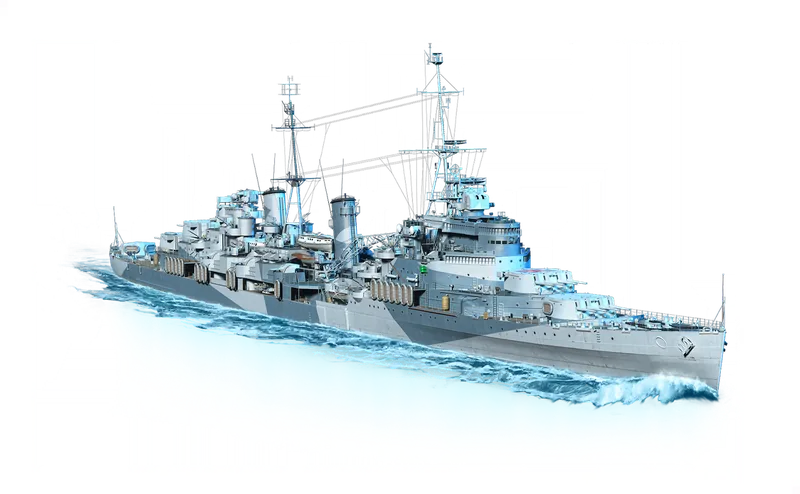
Plymouth, Tier VII Royal Navy light cruiser · open the build from the Ranked season below
Part 1: A decent game, and the ship I was not playing
Start with a battle that looks respectable on the scoreboard. Kitakaze, Standard Domination on Shatter. Defeat, but 53,504 damage and two kills. (open replay 541f8d in Debrief and follow along.) A middling loss with a solid personal line. Nothing on the result screen suggests there is anything to fix.
Here is the same game as Debrief reads it:
Every one of those rows is a symptom. The cause is the first one, and it is the kind of thing you cannot see from inside the match.
Kitakaze's main battery reaches 11.05 km. Half the shells I landed all game landed inside 2,726 m, and the furthest damaging hit of the entire match was 7,025 m. I never used the top third of my own gun range.
It matters more on this hull than on most. Kitakaze's detectability while firing from inside smoke is 2.07 km, the lowest of any Tier VIII destroyer we hold data for, against 6.7 km of surface detection and a 2.5 s reload. Read those three numbers together and the ship is telling you exactly what it is: park in the smoke, shoot for the whole cloud, and nothing further than about two kilometres away can see where the shells are coming from. Sitting at 2.7 km with 100 mm guns throws away the only real edge the hull has, because at that range you are inside everyone's detection, everyone's secondaries, and every torpedo solution on the map.
The rest of the report is what that choice costs. Guns on a lit target 10% of 4:53. A 7 minute 7 second stretch without landing a shell, starting at 2:53. Nine enemies lit to me across the match and hits on exactly one of them, Leepton89, six hits for 7,544, while sargc77 sat lit for 2:32 and was never touched. Those look like separate failures. They are one thing: I was spotting for the team, but not in a way that also added damage or drew enemy fire onto me. Vision on its own is worth something. Vision from a position where you are also shooting, and where the enemy has to answer you, is worth a great deal more.
The ending is the same decision one last time. My ship stops moving at 10:39 and never moves again, 4,672 m from the cap and outside the ring, with three enemies at 4.5, 5.0 and 5.9 km. The last forty-three seconds of the match happen without me. Not defending a point, not contributing to the last exchange, just close enough to everything to be shot at and too far from the objective to matter.
Put plainly: this ship's strength is how little it gives away while shooting from smoke, and I did not use it to contribute damage. Meanwhile the team was overwhelmed early and spent the rest of the match behind. A Kitakaze parked at 9 km in its own smoke, firing continuously at a bloom of 2.07 km, is a real weight on that kind of game. A Kitakaze at 2.7 km is one more ship in the brawl that is already being lost.
So the fix is a position, not an attitude. Next Kitakaze game, fight from 8 to 11 km inside my own smoke: the bloom is 2.07 km, so nothing outside two kilometres learns anything when I open fire, and the guns still reach.
Part 2: A Ranked season, and the slot that decides what Plymouth is
The same review loop, run across a season, changes more than a single habit. I played all of Ranked Season 101 (2v2, Tier VII) in one sitting: 22 games in Plymouth, solo queue, a new random partner every game, watching each replay back before queueing again. Eighteen of them are uploaded and public, so you can watch the same season back: f56e03, c82b7c, 80eaac, e4b823, 9165d4, f608ce, 7f1de5, 477228, bce432 and 32d6a6.
Plymouth forces a choice. Her third consumable slot holds either Smoke Generator or Surveillance Radar, never both, and that single decision changes what the ship is for. I opened the season on Radar and Sonar and finished it on Smoke and Sonar, and the reason I changed was watching the games back rather than reasoning about it beforehand.
The replays kept showing the same thing about the format: the radar had nothing to do. Surveillance Radar earns its slot in three situations. A destroyer you cannot see and need lit. A cruiser firing at range from inside its own smoke. A ship holding an unknown position behind an island. In a two-ship queue at Tier VII, none of those kept happening: there was frequently no destroyer in the match at all, no third ally whose vision I was protecting, and few enough ships on the map that a position was rarely a mystery for long. The slot was dead weight in most games.
Smoke is never dead weight. It buys a reset whenever a fight turns against you, and in a format with no team to carry a mistake, a reset is the difference between losing a ship and losing the match. That is not an argument that smoke is the better consumable in the abstract. It is an argument that a niche tool needs its niche to show up, and in this format it did not.
The season finished 17 wins and 5 losses with 1,319,322 damage across the night, averaging just under 60,000 a game.
One season-level pattern was worth more than the rest. In all sixteen games where my ship survived, we won. In the six where I sank, we won once. In a two-ship format there is no team to carry your wreck, so every plan that ends with "and I probably die doing it" is a coin flip. Treat that as a rule of thumb rather than a measurement, though: it rests on six losses, which is a small sample, and the same night on a different evening could shade it either way.
The best game of the season, 116,922 damage on Mountain Range (replay 9165d4), came after the switch, in the smoke half, and shows exactly what that slot buys when the fight goes wrong:
The Mountain Range game as Debrief renders it. Watch the endgame from 7:21: the smoke goes down, the Tirpitz is re-spotted seventeen seconds later, and the torpedoes finish him at 8:52.
My partner's Jean Bart went down at 5:43 and left me in a 1v2 against a BA Tirpitz. The replay times the endgame precisely: the smoke goes down at 7:21, his spotting on me drops ten seconds later, and the tracking shows him re-spotted at 7:38, seventeen seconds after the puff, as he pushes in. He is under fire from then until he sinks at 8:52. He never got back out.
The inferred commander builds panel is why I finished him with torpedoes rather than a gun duel: it counted three Repair Party uses across the battle, at 3:34, 5:39 and 7:28. A ship healing that often was going to out-sustain a straight exchange, so the finish had to come from flooding rather than shells.
What Debrief shows you
- Tactical map with every witnessed ship's track, scrubbable and speed-adjustable
- Kill feed where clicking a sinking jumps playback to that moment
- Spotting intervals, smoke puffs, consumable activations, torpedo runs
- Cap rings, the match score ticker and the battle timer
- Export the playback as a video to share
- Damage from the scorecard, plus what the replay could attribute
- Total alpha and alpha per minute afloat
- Damage by type, and your estimated share of the team's
- Spotting damage, gunnery hits landed, engagement range
- Longest hit drought and guns-on-lit-targets
- A Base XP estimate broken down term by term
- Potential damage: enemy fire that landed near you
- Potential damage avoided: salvos aimed at you that missed
- Torpedoes evaded, with closest approach
- Enemy exposure: every enemy lit for you, and whether you hit them
- Incoming gunnery hits
- Idle at start, measured from the battle clock rather than the loading screen
- Cap-ring time and time spent capping
- Time in smoke, and damage dealt from it
- Solo endgame detection
- Where you were, and where everyone else was, when you sank
- Inferred commander builds from damage forensics: fire-tick size implies Fight Fire with Fire rank, heal totals count Repair Party uses, salvo cadence falls out of the hit log
- Team rosters with each ship's consumable loadout as chips
- Per-player Base XP estimates and top score contributors
- Concealment estimates where the spotting data supports one
- Damage tanked
- Time spotted, and when you were first spotted
- Damage Control and Repair Party usage
- A live HP bar on your own ship marker
What Debrief cannot show you, and why
Every limit below is a property of the replay file, not a to-do item. Legends writes the battle from your client's point of view, so the file simply does not contain some things, and no amount of work on our side conjures them. Where a number is an estimate or a floor, Debrief marks it with ≈ or ≥ rather than presenting it as fact.
≥.One thing Debrief deliberately does not read: account identifiers. The replay file carries Steam, Xbox, PlayStation and Wargaming account ids, and the uploader never touches them. Nothing that reaches the viewer or our database contains them.
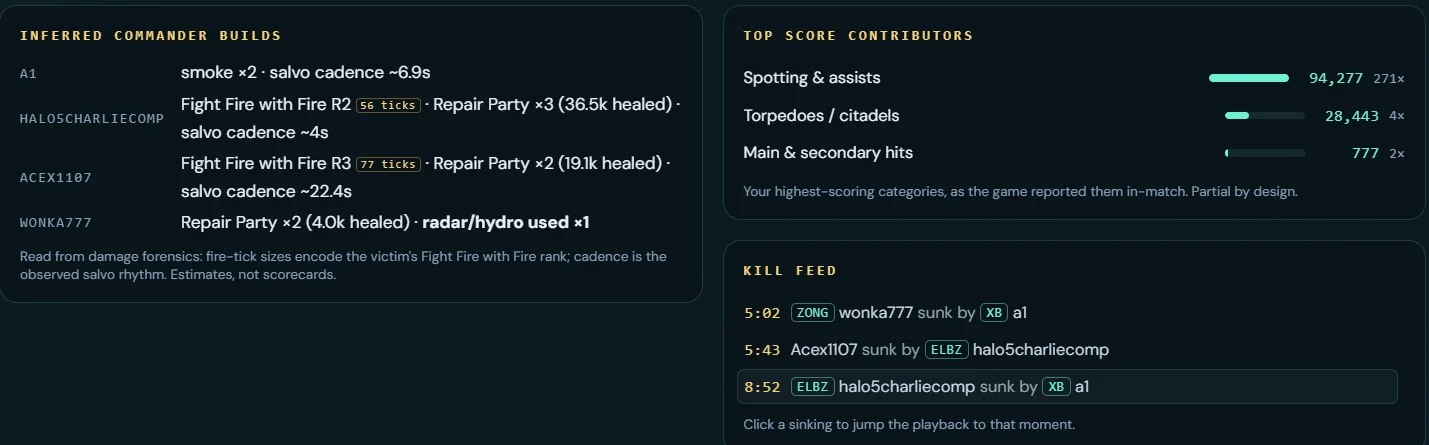
Inferred commander builds, top score contributors, and the kill feed. Clicking a sinking jumps the playback to that moment.
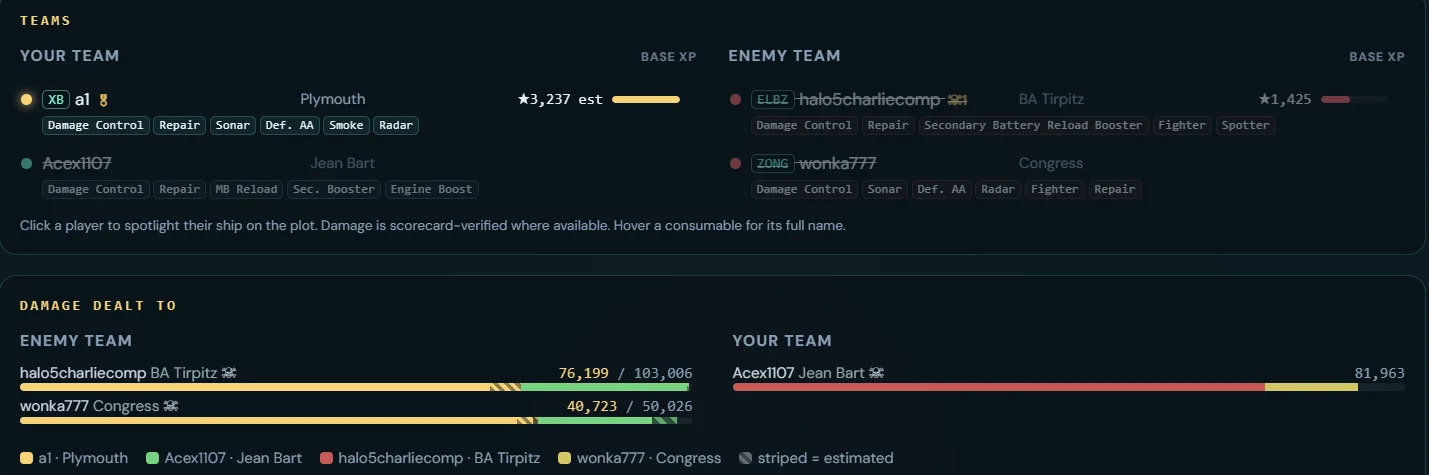
Team rosters with each ship's consumable loadout as chips, which is where the radar-versus-smoke question stares back at you, plus per-player Base XP estimates. The striped portions of the damage bars are flagged as estimates rather than passed off as fact.
How to use it after your next game
Upload the replay and both post-battle screenshots, then read three rows before anything else: guns on lit targets, enemy exposure and longest hit drought. Between them they tell you whether you were participating in the battle you were in. Then scrub to the moment you sank, or to the first cap fight, and watch thirty seconds of it. That is the whole loop, and it is worth more than any amount of reading about builds.
Debrief is in Supporter beta. If you have the PC (Steam) version, your recent games are already sitting in your replays folder waiting to tell you this kind of truth.
Upload a replay